
Top-Rated Chicago
Personal Injury Attorneys
Personal Injury Attorneys
Committed to Maximizing the Value of Your Case



A Chicago clergy sexual abuse lawyer will fight for justice, both for you and your children. Chicago Injury Center’s trauma-informed and compassionate approach minimizes the potential revictimization that can come from a lawsuit while maximizing potential compensation. Contact us today to learn how we hold religious institutions in the Chicago area and throughout Illinois accountable for these injustices.
$14,200,000: Six young men were groomed and fondled by a priest at a large religious school in Oak Park. This priest had been hired despite complaints by students at his previous position.
$2,800,000: This case occurred at a Church-operated summer camp in Crystal Lake. We showed that church officials knew of the allegations but failed to inform parents or remove the offender from the premises.
$2,500,000: Susan was only 11 when a defrocked priest sexually assaulted her at a Humboldt Park church. We utilized Illinois’s new child protection laws to realize a settlement despite the time that had passed.
For nearly 25 years, our sexual abuse lawyers have fought for survivors’ rights, earning us a position in the American Association for Justice and the Illinois Trial Lawyers Association. Our attorneys regularly submit to the National Law Review to share our scholarship on sex abuse in institutions, helping other law firms support survivors in their healing journey. We have won over $450 million for clients nationwide, including those abused by religious institutions.
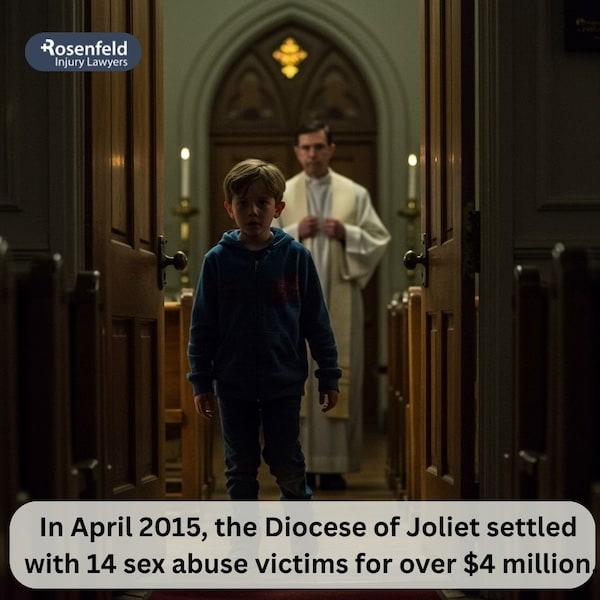
Sexual abuse in the Catholic Church is a well-known problem, and church officials have paid out over $5 billion in settlements over the past two decades. Common forms of sexual abuse that our attorneys see include:
Children who have suffered sexual abuse at the hands of someone they trust have very severe mental health issues throughout their lives, with younger victims of sexual abuse having more extreme symptoms.
These effects can extend well into middle age, entirely changing the course of the person’s life. A recent study by Penn State University found that sexual abuse can even cause a person to age faster due to higher cortisol levels and epigenetic damage.
Common long-term effects of child sexual abuse include:
You may be able to recover both economic and non-economic damages. Economic damages provide financial compensation for expenses associated with recovery, which include:
Non-economic damages consider the devastating impacts of sexual abuse on a person’s overall well-being. These can include:
In some cases, a jury may award punitive damages if religious organizations covered up the abuse or refused to punish the perpetrator.
The average payout for clergy sexual abuse is $3,633,333. Payouts range between $2,700,000 and $5,000,000.
These are only averages, and your financial compensation may be different. Factors that determine what you receive include the victim’s age, the duration of the abuse, whether violence or force was involved, and available insurance.
The unnamed clergy abuse plaintiff was a student at Our Lady of the Westside School (now known as St. Agatha Academy) when he suffered sexual abuse at the hands of Daniel McCormack, a priest who taught math and coached the basketball team. He was in fifth grade and was molested for two years. The Roman Catholic Archdiocese of Chicago settled with him for $3,200,000.00.
Daniel McCormack also abused two brothers at Our Lady of the Westside School, who were 14 and 16 at the time of the assaults. Both children developed PTSD and depression. Again, the Roman Catholic Archdiocese of Chicago settled for $2,700,000.00.
Sexual abuse claims are extremely sensitive, requiring a compassionate and experienced law firm that understands the unique needs of victims. Many survivors are afraid of retaliation, reputational harm, and of facing their attacker in court.
Moreover, these cases involve institutional coverups and statute of limitations challenges. As many victims don’t come forward until years later, vital evidence may have been destroyed, and key witnesses may be reluctant to talk.
Our firm has successfully litigated hundreds of cases against the Catholic Church and other religious institutions that shield predators from consequences. We are highly skilled in preserving evidence, coordinating with multiple liable parties, and protecting a victim’s privacy.
In February 2025, the Archdiocese of Chicago released a 30-page report on sexual predators in the church. The records span almost 100 years. The earliest known perpetrator was ordained in 1917, and the most recent perpetrator was ordained in 2015.
The Office of the Illinois Attorney General performed a thorough investigation into clergy abuse in 2023, with almost 700 pages of research included. In it, the Archdiocese of Chicago is reported to have 275 priests who have been credibly accused of sexual abuse or assault.
However, this number does not fully represent the risks to children that occurred in Chicago’s archdiocese. One priest, Father Daniel McCormack, had 102 allegations of misconduct against him, all of which were received after 1999 when the archdiocese initially began investigating him. McCormack served with the church between the 1980s and 2005, when he was arrested and removed from service.
Another priest, Father Daniel Buck, was allowed to continue serving for over 15 years after initial reports of inappropriate contact with a 15-year-old girl, to whom he wrote love letters and called his “forever friend.” Father Dominic Diederich, who died in 1977, was accused of mistreating at least five children from Saint Maurice in the McKinley Park neighborhood, singling out young girls from economically disadvantaged homes.
This report also highlights how the archdiocese has handled allegations both today and in the past. Prior to 1960, the church handled abuse allegations on a “confessional” model, where priests were forbidden from disclosing anything they heard in confessional to anyone. The perpetrator would be forgiven by the priest, and the incident would not be spoken of again.
Even if a fellow cleric admitted that abuse occurred, the confessor would be shielded from any criminal charges or investigation. This makes it impossible to know how many incidents happened prior to 1960.
Between the 1960s and 1992, the Catholic Church would simply reassign perpetrators to different assignments. During this time, at least 32 members of the clergy were accused of sexual mistreatment, many of whom went on to reoffend.
From 1992 to 2002, offenders were placed on restricted duty and monitored. They were required to complete two years of intensive therapy and four years in a supervised aftercare program in hopes that this would prevent recidivism. Only after this program was complete would they be eligible for an assignment that restricted access to children, meaning that dozens of youths would be vulnerable to abuse while the perpetrator was completing treatment.
Only in 2002 did the Archdiocese adopt a legal model in response to the Dallas Charter, which required investigation of all substantiated allegations, including those of deceased priests or clergy. It was at this time that the Archdiocese implemented its “one-strike” policy, in which any member of the church with a single substantiated accusation would be entirely removed from the ministry.
Sexual abuse in the Catholic Church can occur anywhere that a perpetrator can gain access to a young child. Common locations mentioned in official reports include:
In Illinois, child victims of sexual mistreatment have an extended statute of limitations, recognizing that victims are reluctant to come forward due to fear (735 ILCS 5/13-202.2). Legal action can be taken up to 20 years after the date that the person’s injuries were discovered to be associated with sexual abuse, or within 20 years of the victim turning 18. This statute of limitations does not apply to those who were above the age of 18 at the time of the incident.
Illinois Supreme Court Case Hobert v. Covenant Children’s Home clarifies that this extended statute of limitations applies to non-immediate abusers who had a legal obligation to protect the child from harm. For example, a religious organization, school, or summer camp that was aware of the sexual abuse but chose to protect the perpetrator can still be liable up to 20 years after the date on which the abuse was discovered.
The Illinois Abused and Neglected Child Reporting Act requires mandated reporters to report any suspicions of child abuse or neglect to the authorities (325 ILCS 5/). The law specifically notes that any member of the clergy is a mandated reporter regardless of religious affiliation or vow (325 ILCS 5/4).
However, Illinois, like many other states, privileges confessional and does not require priests to disclose confessions of abuse that were given to them while functioning in their professional capacity (735 ILCS 5/8-803).
Child victims have up to 20 years after turning 18 or 20 years of discovering the clergy abuse, whichever is later (735 ILCS 5/13-202.2). However, this law only applies to those who were under the age of 18 when the abuse occurred. Adult survivors are subject to the standard personal injury statute of limitations, which is two years (735 ILCS 5/13-202)
Our Chicago sexual abuse lawyers will hold all potentially liable parties accountable. This can include:
The Archdiocese of Chicago and other organizations will fight hard to avoid accountability and prevent victims from receiving compensation. However, our attorneys are highly skilled at these claims and will refute their defenses using strong evidence. These are just some of the tactics that negligent religious orders use and how we will counter them.
Statute of Limitations Arguments: While Illinois has vastly expanded the window for reporting, organizations may argue that the abuse occurred earlier than this or that the victim knew their injuries were related to abuse before the deadline. We can work with child psychologists and medical experts to demonstrate that delayed reporting is common in these cases and should not be held against the survivor.
Confessional Privilege: Like other states, Illinois does allow priests to maintain confidentiality for anything disclosed in confessional, meaning that courts cannot force this information to be disclosed. As such, we will look for other evidence that institutions or individuals were aware of the abuse but did not report it, such as letters, written communications, investigations, or witness testimony of conversations with the accused.
Challenging Credibility: Young victims may not be able to explain what happened to them, while older survivors may have forgotten key details. We can work with psychiatrists and other professionals to explain how traumatic memories work and use other evidence to support the claim, even if the victim is not able to fully articulate their experience.
Lack of Evidence: Since survivors may not be able to report the abuse in a timely manner, direct evidence may have been lost or destroyed. Key witnesses may also have passed away or may refuse to cooperate. While this can present a significant challenge, our top-rated lawyers will subpoena the institution for any records, speak to surviving witnesses, and examine medical records to substantiate the claim.
Institution Lacked Knowledge or Involvement: When suing the Archdiocese, individual parishes, or churches, the organization may insist that they were unaware of the abuse or that they did not actively cover up the matter. We can use employment records, previous complaints, and private communications within the church to prove that others were aware of what was happening but failed to act.
While child victims have an extended deadline to file, it is important to act quickly, both to protect the victim and to ensure that you have a strong legal case. Follow these steps as soon as possible.
Our compassionate Chicago attorneys will help you understand your legal options while prioritizing the victim’s mental health and privacy at all times. We provide confidential legal guidance to victims and can petition to have the case filed under a pseudonym. As we will handle all communication with third parties, the victim and their loved ones can focus on healing.
Whether the abuse happened recently or years prior, we will investigate and gather strong evidence to prove negligence on behalf of the individual, their employer, and other organizations. This can include employment records, parish assignments, testimony from other victims, medical reports, therapy records, and intraorganizational communications.
We are highly skilled at negotiation and can effectively counter the insurance company’s refusal to provide fair settlements. Throughout the process, we will keep you informed while still protecting your privacy and well-being.
Many assault claims are settled out of court, sparing the victim the need to face their accuser or recount their story for a jury. However, it is sometimes necessary to go to trial, so we prepare every case as if we will represent you in front of the Circuit Court of Cook County. We will share your narrative with the jury, protect your privacy, and ensure you have the highest possible chance of compensation.
Throughout the process, we can direct you to helpful resources, such as counseling centers, that can help you and your family heal. Our trauma-informed processes prioritize your well-being and empower victims to take control of their narrative, offering both emotional and financial recovery.
What are the warning signs of sexual abuse among children?
According to the Rape, Abuse, and Incest National Network, signs of sexual abuse in young children include:
Which priests have been accused of abuse in the Archdiocese of Chicago?
The Archdiocese of Chicago has released a list of clergy members who have been accused of sexual abuse, listed by name, date of ordination, and prior positions.
What is the typical clergy abuse offender profile?
Palo Alto University notes that members of the clergy who perpetrate abuse typically have these characteristics:
However, it is important to note that sexual offenders are heterogeneous, and some perpetrators may not meet these criteria.
How much does a clergy sexual abuse attorney cost in Chicago?
We work on a contingency fee basis – no fees unless we win.
Will my identity be kept confidential during the case?
Our sexual abuse attorneys can petition the court to let you file under a pseudonym, such as John Doe or Jane Doe.
Who can file a wrongful death claim if abuse leads to suicide?
According to the Wrongful Death Act, the identified next of kin can file a lawsuit (740 ILCS 180/). This may be parents, spouses, surviving children, or siblings.
Sexual abuse by a trusted church leader or clergy member can be devastating, leading to lifelong consequences for victims. We fight hard for fair compensation while also empowering victims to speak out against corrupt institutions. Our empathetic attorneys work on a contingency fee basis, so you owe us nothing unless we win. Contact us today to learn about your legal options and start your journey to justice.
Content reviewed by Chicago personal injury lawyer Jonathan Rosenfeld of Rosenfeld Injury Lawyers LLC, who holds negligent individuals, corporations, and institutions accountable to secure justice and compensation for injured victims and their families, and is a trial lawyer recognized by Super Lawyers, the National Law Journal, and the National Trial Lawyers organization.