
Top-Rated Chicago
Personal Injury Attorneys
Personal Injury Attorneys
Committed to Maximizing the Value of Your Case



Complex regional pain syndrome (CRPS) is a devastating syndrome typically caused by traumatic injury. If you’re suffering from chronic pain due to someone else’s negligence, our selected Chicago CRPS lawyer can help. Contact us today for a free consultation about your legal options.

Our personal injury attorneys have secured significant settlements for our clients, which cover ongoing medical care and other necessary expenses. These are just a few of the settlements that have earned us membership in the Million Dollar Advocates Forum.
$5,250,000: Tim, a motorcycle driver, lost his leg in a motor vehicle accident when a car turned into his lane. He suffered from widespread pain and required long-term treatment.
$2,800,000: Lupe was walking on the sidewalk when a rideshare driver veered into him, causing significant pain and suffering.
$720,000: Alex was rear-ended by a semi-truck but thought he was okay. After suffering severe pain, he found that he had a serious back injury that required surgical procedures.
Our personal injury lawyers have secured over $490 million in settlements and verdicts on behalf of our clients, ensuring they have the funds they need to recover in comfort. With a 10/10 AVVO rating and an A+ rating by the Better Business Bureau, we have demonstrated our steadfast commitment to high-quality legal representation, and we’re ready to help you, too. Contact us today for a free legal consultation about your nerve injury case.
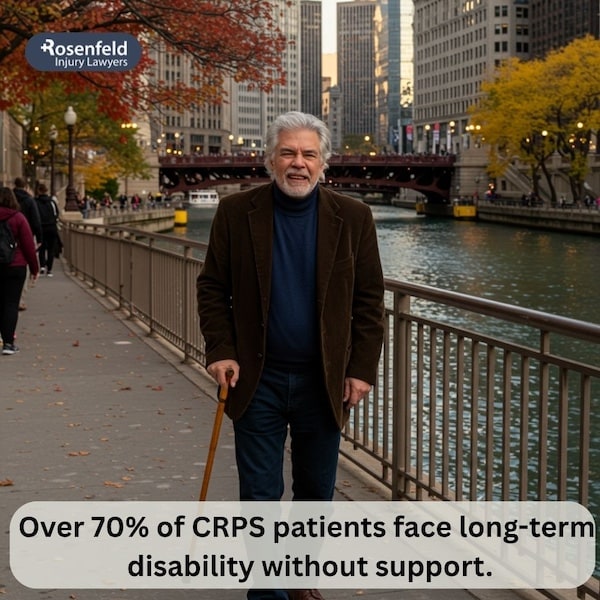
Complex regional pain syndrome, also known as reflex sympathetic dystrophy syndrome (RSD), is a debilitating condition that is more common after a traumatic injury. Common causes of CRPS include:
Complex regional pain syndrome (CRPS) is a chronic illness that occurs when the sympathetic nervous system sends persistent pain signals even after the initial injury site has begun to heal. This neurological disorder typically affects an arm or leg, giving it the older name of shoulder-hand syndrome.
The affected limb will demonstrate exaggerated muscle atrophy, lower skin temperature, changes to skin color and texture, and persistent stinging pain.
There are two main types of CRPS. Type 1, also known as reflex sympathetic dystrophy (RSD), occurs without a distinct nerve injury, while Type 2, known as causalgia, happens without a distinct nerve injury.
Symptoms typically progress in three stages, which are as follows.
Stage 1 (Acute): Victims may suffer stinging or burning pain in the affected area. There may be decreased range of motion, temperature changes, and faster-than-normal hair growth. A proper diagnosis and early treatment can prevent the disease from progressing.
Stage 2 (Dystrophic): In this stage, complex regional pain syndrome (CRPS) victims suffer from increased pain, swelling, and muscle wasting. Other symptoms include changes to skin temperature, color, thickness, and sensitivity.
Stage 3 (Atrophic): The severe pain begins to spread further, and victims may suffer contractures (tightening of muscles and ligaments) and muscle wasting. Blood flow is reduced, and osteoporosis can set in.
Medical professionals do not fully understand why some people develop CRPS and others don’t, but it may involve an interplay between the immune system and nervous system.
Diagnosing CRPS can be challenging as there is no singular test. Typically, healthcare providers will offer a physical examination and rule out other potential diagnoses. If you treat CRPS early with pain medication and physical therapy, you can prevent disease progression.
Our experienced attorneys will secure compensation for complex regional pain syndrome (CRPS) that covers all your needs, including the following.
Your medical bills can include:
Many chronic pain sufferers can no longer work full-time or are placed on permanent disability. We will evaluate your total lost wages and future lost income.
Complex regional pain syndrome can lead to significantly reduced quality of life and severe emotional distress. Non-economic damages we can secure include:
The average payout for complex regional pain syndrome (CRPS) is $3,335,529. Factors that influence your payout include available insurance policies, injury severity, overall expenses, and whether you have high-quality legal representation.
Julian Andrades was shopping at Menards in Morton Grove when he was struck by a forklift operated by a store employee, which ran over his foot. Andrades developed CRPS in the affected limb, leading to long-term disability and continuous pain. The Cook County District Court awarded him $13,003,023.99.
An experienced Chicago CRPS lawyer is crucial to winning these cases, as complex regional pain syndrome is a medical condition that not every law firm understands. Having assisted numerous clients suffering from CRPS, we’re familiar with the devastating pain and long-term disability this disorder can cause.
By partnering with medical experts and adhering to local laws, we can ensure you have the best chance of receiving maximum compensation for your injuries.
The Illinois Pain & Spine Institute notes that women are three times more likely than men to be diagnosed with CRPS, and approximately 50% of patients will have residual impairment. 75% of patients return to near baseline function. Most patients are around 40 years old, with younger people rarely affected.
Between 51% and 89% of all CRPS patients suffer from pain and motor dysfunction at 12 months, showing that this is a long-term condition that requires careful management.
If you developed CRPS after a work-related injury, you may be eligible for workers’ compensation. The Illinois Workers’ Compensation Act requires employers to maintain this insurance to cover lost wages and medical care following a work-related accident (820 ILCS 305).
To claim workers’ comp, you must demonstrate that your accident or injury was directly related to employment. Illinois Supreme Court cases, such as McAllister v. Illinois Workers’ Compensation Commission, prove that it’s possible to secure compensation for injuries like a knee injury sustained while rising from the ground.
Those who were injured outside of the workplace can file a personal injury lawsuit if they can prove that the defendant was primarily responsible for the injury. Illinois uses modified comparative negligence, meaning you can sue as long as you were not more than 50% responsible for the accident (735 ILCS 5/2-1116).
The Illinois statute of limitations for personal injury is two years (735 ILCS 5/13-202). Contact a skilled attorney as soon as possible to ensure that you do not miss this deadline. For workers’ compensation, you have three years from the date of injury or two years after the last paycheck from the employer, whichever is later (820 ILCS 305).
Drivers: If you were in a motor vehicle crash, you can sue the driver for negligence.
Property Owners: Those injured due to someone else’s negligence can seek compensation from the owner’s insurance.
Companies: Stores, restaurants, construction companies, and transit companies can be held liable for negligence.
Government Agencies: Individuals injured on government property may be eligible to sue the city of Chicago for their medical expenses.
Manufacturers: In some cases, people are hurt by defective products, and the manufacturer can be liable.
Dismissing CRPS: Because complex regional pain syndrome is a rarer disorder, the insurer may claim that it’s not a real condition or that you were misdiagnosed. We’ll work with medical professionals to legitimize your claim.
Preexisting Conditions: The insurance agency may insist that you suffered from pain prior to the accident or that you were predisposed to the condition. We can use medical records to prove otherwise.
Assumption of Risk: Another common defense is that you accepted the risk of injury by engaging in activities like driving or sports. We can prove that chronic pain is not an acceptable level of risk.
Comparative Negligence: Your personal injury lawyer must demonstrate that you were not the primary cause of the accident that led to developing CRPS by using evidence.
Get Medical Treatment: Immediately visit the local ER, such as UChicago Medicine.
Report the Incident: If this is a workplace accident, inform your supervisor or tell the property owner about what happened. Ensure you receive this in writing.
Document the Accident: Get photos and videos of the accident scene, including your injuries.
Continue Receiving Treatment: Continue your CRPS treatment regimen and follow all doctor’s instructions, as this demonstrates continuity of care.
Collect Evidence: Show your expenses through receipts, invoices, and bills. Collect witness statements and document your recovery process through photos and narratives.
Do Not Speak to Insurance Adjusters: Never speak to third parties without attorneys present, as they will use anything you say against you.
Contact an Attorney: We will help you explore your legal options and protect your rights throughout the process. Contact us for a complimentary consultation.
Case Evaluation: Using settlement calculators, we’ll determine what a fair settlement would be in your case. This will include non-economic damages like pain and suffering or loss of enjoyment of life.
Investigation: We will gather evidence like medical records, incident reports, surveillance footage, and witness statements.
Liability: After reviewing the evidence, we’ll identify all potentially liable parties and serve them with a complaint.
Testimony: Our team will interview any witnesses and consult with medical experts to gain a deeper understanding of how CRPS has affected you.
Filing Paperwork and Demand Letters: We will file a complaint with the Cook County Circuit Court and write a demand letter for the applicable insurance agency.
Negotiating With Insurance: Insurers will do everything to minimize their liability, but we will aggressively negotiate for a fair settlement.
Trial Representation: Many CRPS cases settle out of court, but it’s sometimes necessary to go to trial if the insurer refuses to offer a reasonable settlement. We will share information with the other parties, attend hearings, file motions, and present your story to a judge and jury.
Our attorneys work on a contingency fee basis, meaning that you owe us nothing unless we earn you a settlement.
Complex regional pain syndrome (CRPS) is not included in the Social Security Administration’s Blue Book of medical conditions, but you can request a Residual Functional Capacity Evaluation that can demonstrate your impairment.
No, CRPS is not a psychological condition. Rather, it is a nervous system disorder that leads to severe pain even after the affected limb has healed.
Diagnosing CRPS requires a physical exam and tests to rule out other diseases, such as autoimmune diseases.
This depends on how long your CRPS diagnosis was delayed. Illinois has a delayed discovery rule that pauses the statute of limitations until you are diagnosed with a disorder.
In many cases, this can be included as part of a fair settlement. Intrathecal pain pumps, also known as internal pain pumps, deliver pain medication directly to the spinal cord. To have this covered, medical professionals must attest that other pain management solutions have not worked.
Before being prescribed a pain pump, you may receive physical therapy, corticosteroids, antidepressants, anticonvulsants, nerve blocks, or spinal cord stimulation (SCS) to see what may work. Other symptom management options include biofeedback or ketamine therapy.
With a proven track record of success in over 5,000 cases, our personal injury lawyers are recognized for their aggressive pursuit of fair compensation. We work on a contingency fee, meaning you owe us nothing unless we secure a favorable outcome. Contact us today to schedule a complimentary consultation about your legal options.
Content reviewed by Chicago personal injury lawyer Jonathan Rosenfeld of Rosenfeld Injury Lawyers LLC, who holds negligent individuals, corporations, and institutions accountable to secure justice and compensation for injured victims and their families, and is a trial lawyer recognized by Super Lawyers, the National Law Journal, and the National Trial Lawyers organization.