
Top-Rated Chicago
Personal Injury Attorneys
Personal Injury Attorneys
Committed to Maximizing the Value of Your Case



At the Chicago Injury Center, we’ve seen firsthand how dangerous a slip and fall on ice and snow can be in our city. From icy sidewalks along Michigan Avenue to unshoveled parking lots outside neighborhood grocery stores, these hazards put residents and visitors at risk every winter. Our team of top-rated Chicago slip and fall lawyers fights to hold negligent property owners accountable and recover the compensation our clients need to move forward.
When you’ve been hurt in a slip and fall accident on Chicago’s icy sidewalks or snowy parking lots, you need a legal team with the skill and track record to take on negligent property owners. At Chicago Injury Center, we’ve been representing injury victims for 25 years, recovering more than $490 million in settlements and verdicts.
Our reputation has been built on consistent results and recognition from respected organizations like the Million Dollar Advocates Forum, Super Lawyers, the American Association for Justice, and the Illinois Trial Lawyers Association.
One case that stands out involved our client, Emily, who fractured her pelvis after a fall on ice while walking outside a church on Chicago’s West Side. The church had failed to salt a slick patch of walkway hidden beneath fresh snow. We gathered witness statements, weather reports, and maintenance records to prove negligence, ultimately securing a $2,000,000 settlement that covered her medical care, lost wages, and rehabilitation.
In Chicago, a slip and fall accident on snow and ice can happen almost anywhere in the winter months. We’ve represented clients injured on icy sidewalks along State Street, in unshoveled parking lots outside Mariano’s and Jewel-Osco locations, and at CTA station entrances where wet snow refreezes into dangerous slick spots. Black ice is especially common near intersections like Clark and Division or on shaded stretches of neighborhood streets in Rogers Park, Bronzeville, and Back of the Yards.
Commercial properties aren’t the only problem. We’ve seen slips and falls on slick surfaces in residential driveways, apartment building entryways, and school parking lots across the city. Busy areas like Navy Pier, Millennium Park, and the United Center can also become treacherous if property owners and maintenance crews fail to remove snow or treat ice in a reasonable time.
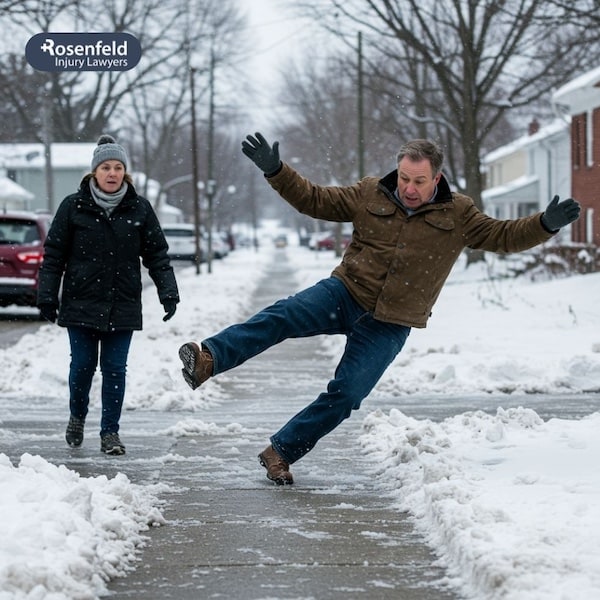
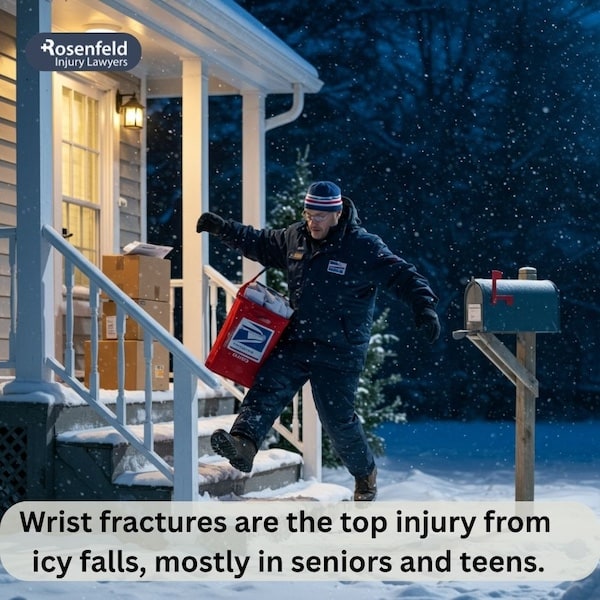
A slip and fall on ice and snow can lead to more than just bruises. Common injuries we’ve seen clients suffer include broken bones, torn ligaments, and traumatic brain injuries after landing hard on slick pavement. Hip fractures are common among older adults, while younger victims may experience wrist or arm fractures from trying to break their fall.
Under the Illinois Premises Liability Act (740 ILCS 130/), property owners have a legal duty to maintain their premises in a reasonably safe condition for lawful visitors.
Illinois follows the natural accumulation rule, which means property owners generally aren’t liable for injuries caused by the natural buildup of snow and ice. To succeed in these cases, an injured party often must prove that the hazard resulted from an unnatural accumulation or from negligent snow and ice removal.
The Illinois Snow and Ice Removal Act (745 ILCS 75/) provides certain liability protections for residential property owners who make a good faith effort to remove snow and ice from sidewalks. This law doesn’t apply to commercial properties or to situations where willful or wanton misconduct is involved.
Illinois law no longer distinguishes between invitees and licensees, and both are owed the same duty of reasonable care under the Premises Liability Act. This means a property owner must take steps to keep conditions reasonably safe for lawful visitors. Trespassers are treated differently and are only protected from willful or wanton misconduct, with some exceptions for children.
For a slip and fall involving snow and ice in Chicago, the foundation is proving that the property owner’s negligence created or failed to correct a dangerous condition.
If a property owner or manager knowingly ignores a dangerous condition — for example, leaving a slick sheet of ice at a building entrance used daily by tenants — that disregard for safety can rise to willful or wanton misconduct.
Improper removal efforts can make conditions worse. Piling snow in an area where it melts and refreezes across a walkway, or failing to salt a known icy spot in a parking lot, can create an unnatural accumulation and open the door to liability.
Sloped walkways that allow water to drain and freeze, broken gutters that cause runoff onto sidewalks, or cracked pavement that traps ice can all contribute to unsafe conditions. These design or maintenance failures can strengthen a claim.
Commercial leases and residential rental agreements often assign responsibility for snow and ice removal. If a landlord, property manager, or maintenance contractor ignores those obligations, they may be liable for resulting injuries.
Case law, such as Hornacek v. 5th Ave. Property Mgmt., shows how courts analyze whether the hazard was natural or unnatural and whether the owner’s actions directly caused the dangerous condition. This makes it critical to gather detailed evidence, from maintenance logs to weather reports, to connect the accident to the owner’s conduct.
When someone suffers a slip and fall accident on snow and ice in Chicago, our work begins immediately. We investigate the scene and circumstances of your case, secure photographs before conditions change, and interview witnesses who saw the fall or the hazardous area. Weather reports, maintenance records, and city inspection logs often become critical in proving that the property owner failed to exercise reasonable care.
We also coordinate with medical providers to document the full scope of injuries and their long-term effects. These medical records help establish the connection between the accident and the client’s losses, from treatment costs to the impact on daily life.
As the case develops, we handle all communication with insurance companies and defense lawyers, protecting our clients from tactics that aim to minimize payouts. Whether the claim is resolved through negotiation or in court, we build the case with the same goal: securing full compensation.
Because our attorneys know Chicago’s neighborhoods, local ordinances, and even the tendencies of judges in Cook County courts, we’re able to navigate these cases with insight that out-of-town firms can’t match.
Liability for a slip and fall accident on snow and ice in Chicago often depends on who had control over the property and a duty to keep it safe. This can include:
In some situations, liability is shared. For example, a lease agreement between a landlord and a commercial tenant might assign snow removal duties to the tenant, but if both parties ignore those responsibilities, both may be held liable.
Victims of a slip and fall accident on snow and ice in Chicago may be entitled to recover compensation for both economic and non-economic losses. Economic damages can include emergency room bills, rehabilitation costs, and lost wages during recovery. Non-economic damages address the pain, emotional distress, and loss of enjoyment of life caused by the injuries.
In serious cases — such as those involving traumatic brain injuries or permanent mobility issues — damages may also account for future medical care, home modifications, and the need for ongoing assistance.
The average payout for a snow and ice slip and fall accident in Chicago is approximately $575,823, with a median value of $170,000. Case values can range widely — from under $16 for minor injuries to $5,000,000 verdicts for severe or permanent harm.
Payout amounts vary depending on several factors, including:
In one case, Michael Berk fractured his ankle after slipping on black ice outside Pepper Construction’s property on North Orleans Street. Evidence showed the company had plowed snow into a parking lot area where it melted and refroze onto the sidewalk, creating an unnatural accumulation. After multiple surgeries, ongoing pain, and activity limitations, Berk was awarded $2 million.
At O’Hare International Airport, pilot Jim Reiners claimed he slipped on ice while exiting a plane, suffering a herniated disc that required surgery. The jury found United Airlines 72% liable for failing to maintain a safe environment. His damages totaled $1,740,600, later reduced for comparative fault to $1,253,232.
In another case, Janusz Bruszniewski slipped on ice at a Joliet construction site caused by water draining from a sprinkler test. He sustained a severe femur fracture, needed multiple surgeries, and faced permanent limitations. The jury found the subcontractor 80% liable, awarding Bruszniewski $1,221,282, which was reduced to $977,026 for comparative fault, then offset by a prior settlement.
What you do right after a fall accident is crucial to building a solid case. Key steps include:
In Illinois, the statute of limitations for most personal injury claims — including slip and fall accidents on snow and ice — is two years from the date of the injury (735 ILCS 5/13-202). This means you must file your lawsuit within that time frame or risk losing your right to seek compensation.
If the claim is against a city, county, or other government entity, stricter notice requirements may apply under the Local Governmental and Governmental Employees Tort Immunity Act. In some cases, you must file a formal notice within one year of the accident.
How do I know I have a viable case?
If your fall was caused by an unnatural accumulation of snow or ice — such as melting snow refreezing on a walkway because of poor drainage — you may have a claim.
Are there any differences in liability between commercial and residential properties?
Yes. Commercial property owners are generally held to a higher standard of care for keeping public areas safe. Illinois’ Snow and Ice Removal Act provides some protection for residential owners who make good‑faith efforts to clear snow, but it doesn’t apply to businesses.
What do I need to prove in a slip and fall case involving snow and ice?
You must show four things: the property owner had a duty to keep the area safe, they breached that duty, their negligence caused your accident, and you suffered damages as a result.
What evidence do I need?
Photos or videos of the accident scene, witness contact information, maintenance logs, and medical records are all valuable. We can help collect and preserve this evidence if you contact us quickly after the fall.
Can falls on snow and ice be prevented?
Yes, proper salting, shoveling, and drainage maintenance greatly reduce the risk.
Can I sue for slipping and falling on black ice?
Yes, if we can prove it resulted from an unnatural accumulation or another hazard that the property owner should have addressed. Black ice cases often require expert testimony to connect the hazard to negligent maintenance.
If you sustained fall injuries on ice and snow on someone else’s property in Chicago, you don’t have to take on the property owner or their insurance company alone. At Chicago Injury Center, we work on a contingency fee basis, meaning you pay nothing unless we win your case.
Well-versed in personal injury law, we’ve helped clients across Illinois recover the compensation they deserve. Let us put our extensive knowledge, resources, and local experience to work for you. Call us today or fill out our online form.
Content reviewed by Chicago personal injury lawyer Jonathan Rosenfeld of Rosenfeld Injury Lawyers LLC, who holds negligent individuals, corporations, and institutions accountable to secure justice and compensation for injured victims and their families, and is a trial lawyer recognized by Super Lawyers, the National Law Journal, and the National Trial Lawyers organization.