
Top-Rated Chicago
Personal Injury Attorneys
Personal Injury Attorneys
Committed to Maximizing the Value of Your Case



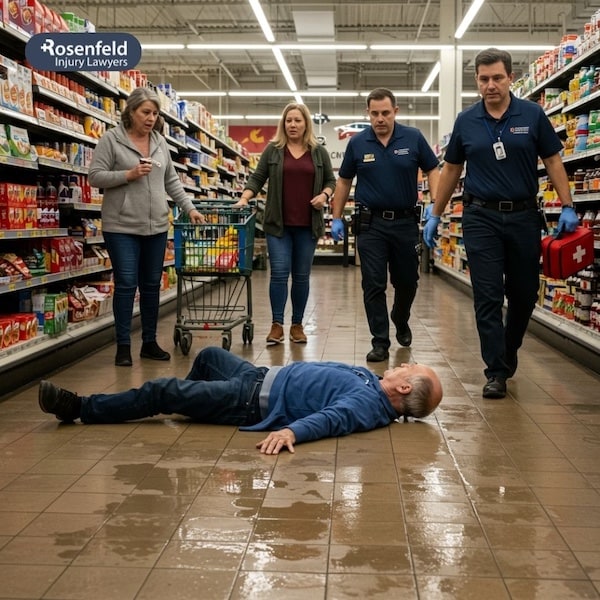
At the Chicago Injury Center, we’ve seen firsthand how devastating wet floor slip and fall accidents can be. From puddles in the produce aisle at Mariano’s to freshly mopped hallways in downtown office buildings without proper wet floor signs, these hazards send countless Chicagoans to the emergency room every year. Our team of top-rated Chicago slip and fall lawyers knows how to hold negligent property owners accountable and fight for the full compensation our clients deserve.
For more than two decades, we’ve represented Chicago residents in some of the toughest premises liability cases, taking on everyone from local shop owners to major national chains. Our work has been recognized by Super Lawyers, the Million Dollar Advocates Forum, and the Illinois Trial Lawyers Association, and we maintain a perfect AVVO score. These honors reflect one thing: we fight hard for our clients and get results.
One example is Maria’s case. She was shopping at a large chain store on the Northwest Side when she slipped on spilled food that had been left on the floor for over an hour. No wet floor signs were in place, and security footage showed employees walking by without cleaning it up. Maria broke her arm in the fall and faced weeks of recovery.
We gathered the footage, spoke to witnesses, and obtained maintenance records showing the store’s cleanup policy wasn’t followed. That case resolved with a $1,200,000 recovery, enough to cover her medical bills, replace her lost wages, and compensate her for what she’d been through.
Yes, if a property owner fails to warn visitors about wet floors, it can be grounds for a claim. In Chicago, we’ve seen this happen in stores, office buildings, and transit stations where spills or mopping create hazards. Without a clearly placed wet floor sign, people may walk straight into danger.
The missing sign alone isn’t enough, however. We still have to show the hazard existed long enough to be addressed or that the staff created it. That’s why we act quickly to gather evidence, such as surveillance footage and witness accounts.
In Chicago, property owners should post clear wet floor signs any time a surface becomes slick enough to cause a fall. This includes:
Without proper warning, visitors can easily walk into a hazard, and the property owner may be held liable if someone is hurt.
Falls on wet floors can cause a wide range of injuries, from temporary soreness to serious injuries and permanent disabilities. We’ve represented Chicago clients with:
In a wet floor slip and fall case, we have to show that the property owner’s negligence directly caused the injury. That means proving four key elements:
We often use maintenance records, surveillance footage, and witness statements to prove the hazard existed and should have been addressed. In Chicago, this evidence is especially important when incidents happen in busy places.
While property owners are often the first ones we investigate, they aren’t the only parties who can be responsible for slippery floor fall accidents in Chicago. Depending on the situation, we may also pursue:
Identifying every responsible party early is critical, as it helps us maximize recovery for our clients and ensures no one who contributed to the hazard escapes accountability.
The steps you take immediately after a slippery floor fall accident can make or break your premises liability claim. We recommend:
Slip and fall accidents on wet floors in Chicago are generally covered under the Illinois Premises Liability Act (740 ILCS 130/). This law requires property owners and those in control of a property to maintain it in a reasonably safe condition for lawful visitors. Failing to clean up floors promptly or neglecting to post visible wet floor signs can be considered a breach of this duty.
Illinois follows a comparative negligence rule (735 ILCS 5/2-1116). If you’re found partially at fault for the fall — for example, if you ignored a visible warning sign — your percentage of fault may reduce your recovery. You can still recover damages if you’re less than 51% responsible.
In Zuppardi v. Wal‑Mart Stores, Inc., 770 F.3d 644 (7th Cir. 2014), the court analyzed whether the store had actual or constructive notice of a liquid spill that allegedly caused a customer’s fall. The decision emphasized that, in Illinois, a plaintiff must show the property owner knew or should have known about the hazard in time to correct it.
Under Illinois law, you generally have two years from the date of the fall to file a slip and fall lawsuit (735 ILCS 5/13-202). If the claim is against a government entity, notice deadlines can be much shorter.

In a slippery floor case, we work to recover both economic and non‑economic damages for our clients. Economic damages cover measurable costs like medical bills, lost wages, and rehabilitation expenses. Non‑economic damages compensate for pain, emotional distress, and the overall impact the injuries have on daily life.
In severe cases — such as those involving traumatic brain injuries or long‑term mobility problems — damages may also include the cost of future medical care, assistive devices, and home modifications. Every case is unique, and the value depends on the severity of the fall injuries, the strength of the evidence, and the degree of fault assigned.
The average payout for slippery floor fall accidents in Chicago is about $403,364, with a median value of $335,000. Awards can range from as little as $8,000 for minor injuries to over $1 million for severe cases.
Several factors influence where a case falls on this spectrum, including:
Jeffrey Acker, an ironworker, slipped on wet bentonite in the basement of a DePaul University building in Chicago. Multiple contractors were involved, and evidence showed the water leakage hazard wasn’t addressed. Acker tore his rotator cuff, required two surgeries, and could not return to full-duty ironwork. The parties reached a pretrial settlement totaling $1.16 million.
Judd Daniels, who used crutches due to a congenital condition, fell on a wet floor while exiting a restaurant. There were no slippery floor signs, and testimony confirmed no mopping had been observed that day. Daniels suffered severe arm fractures and became mostly confined to a wheelchair. The jury awarded Daniels and his wife $1,075,000, including loss of consortium.
Christina Viernum slipped on wet tile after walking over damp carpet at her Chicago workplace. The maintenance company responsible for cleaning failed to follow safety protocols and post hazard signs. Viernum fractured her patella, underwent multiple surgeries, and claimed lasting pain. She was found 40% at fault, reducing her $593,264.01 award to $355,958.40.
We’ve seen slip and fall accidents in almost every type of public and private space across Chicago. Some of the most common locations include:
Yes. If you were injured on the job, you may have a workers’ compensation claim and, in some cases, a separate claim against a third party — such as a cleaning company or building owner — whose negligence contributed to the fall.
If it’s a workplace injury, workers’ compensation should cover treatment costs. In other situations, your health insurance or MedPay coverage might pay first, and we work to recover those expenses in your claim so you’re not left with mounting medical bills.
We work on a contingency fee basis. That means you don’t pay us anything upfront, and our fee comes as a percentage of the recovery if we win your case.
Property owners should address spills right away, use mats in entryways during bad weather, and post caution signs whenever surfaces are slick. Regular inspections and maintenance reduce the risk of dangerous conditions that lead to falls.
If you’ve been hurt in a slippery floor fall accident in Chicago, you have legal rights, and we’re here to protect them. At Chicago Injury Center, our experienced attorneys know how to prove liability, deal with insurance companies, and fight for the full compensation you deserve.
We handle cases on a contingency fee basis, so you pay nothing unless we win. From investigating the accident scene to negotiating settlements or taking your case to trial, we’re committed to helping injury victims seek compensation for their injuries.
Call us today or complete our online contact form to schedule your free consultation.
Content reviewed by Chicago personal injury lawyer Jonathan Rosenfeld of Rosenfeld Injury Lawyers LLC, who holds negligent individuals, corporations, and institutions accountable to secure justice and compensation for injured victims and their families, and is a trial lawyer recognized by Super Lawyers, the National Law Journal, and the National Trial Lawyers organization.