
Top-Rated Chicago
Personal Injury Attorneys
Personal Injury Attorneys
Committed to Maximizing the Value of Your Case



Being injured on the job can be life-changing, but a Chicago workers’ compensation lawyer from our team can help you get back on track. We represent injured employees across Cook County and throughout Illinois who need benefits under the Workers’ Compensation Act.
At Chicago Injury Center, we fight to recover compensation for medical bills, lost wages, disability benefits, and other support injured workers deserve. Whether you are a construction worker, healthcare employee, union worker, or anyone else hurt while performing job-related duties, we know how to hold insurance companies and employers accountable.

A 42-year-old union carpenter fell through unsecured roof decking on a Chicago construction site where no fall protection was provided. Despite clear safety violations, supervision was lacking. His family pursued a wrongful death claim, and our law firm secured an $11.75 million settlement for their devastating loss.
A 45-year-old electrician fell from an unstable ladder while wiring a new warehouse, suffering spinal fractures and a traumatic brain injury. Unable to return to work, he faced lifelong earning losses. Through litigation, we proved contractor negligence and achieved a $7.2 million settlement on his behalf.
A 56-year-old railyard worker suffered permanent foot damage when a shipping container was dropped during loading. His injuries ended his railroad career. We showed the employer’s unsafe practices and won a $2.8 million settlement for his medical care and lost earning capacity.
At Chicago Injury Center, our Chicago workers’ compensation attorneys are known for standing up for injured workers and achieving results that make a difference. Our lawyers have been recognized by organizations such as Super Lawyers and maintain a 10/10 rating on Avvo, reflecting our commitment to excellence in workplace injury litigation. We have successfully handled complex claims under state workers’ compensation law, from traumatic accidents to repetitive stress injuries and permanent disability.
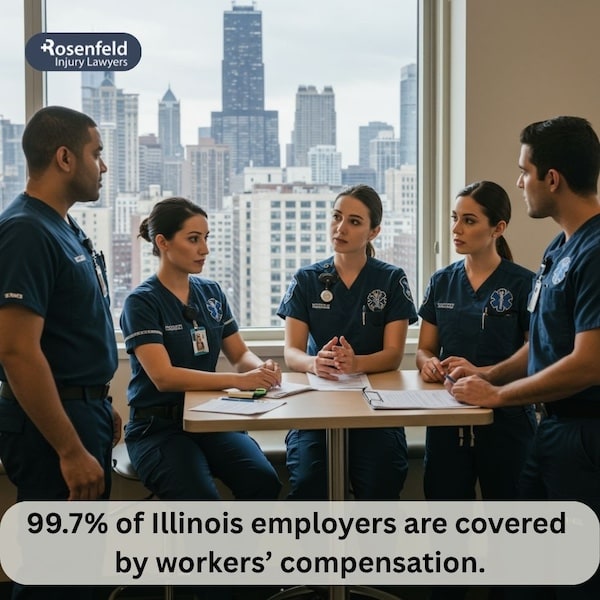
The Illinois Workers’ Compensation Act (820 ILCS 305/) refers to a no-fault system designed to protect employees who suffer work-related injuries or occupational illnesses. It requires most employers to carry workers’ compensation insurance, which pays for medical expenses, lost wages, and disability benefits.
While most employees injured while performing job-related duties can receive workers’ compensation benefits, there are specific exceptions. If an employer intentionally causes harm, for example, through a physical assault, the injured worker may have the right to bring a personal injury lawsuit instead of a workers’ comp claim. Injured employees also have the right to file a civil claim if an employer fails to carry workers’ comp insurance, which is required under Illinois law.
Other exclusions include self-inflicted injuries, incidents tied to criminal activity, or cases where intoxication is proven to be the primary cause of the workplace accident. Certain occupational diseases and toxic exposures may also allow workers to pursue civil claims outside of the workers’ compensation system.
While most employees are protected under the Workers’ Compensation Act, several groups fall outside the system or may be covered under federal laws instead. Business owners, such as sole proprietors or partners, are not automatically covered unless they elect to carry workers’ comp insurance for themselves.
Independent contractors are another excluded category, though disputes often arise when employers misclassify workers to avoid providing benefits. Other groups not typically covered include casual laborers hired for irregular or short-term tasks, domestic workers in private homes, and some farm employees on small family operations.
In addition, certain industries rely on federal protections: railroad workers are covered under the Federal Employers’ Liability Act, and maritime workers fall under the Jones Act or Longshore Act. To understand your eligibility, speak with the Chicago workers’ compensation attorneys at Chicago Injury Center.
Illinois’ workers’ compensation system provides injured workers with several different types of benefits.
Temporary total disability applies when an employee is entirely unable to work while recovering from a job-related injury. In Illinois, these benefits equal two-thirds (66⅔%) of the worker’s average weekly wage (AWW). Payments begin after a three-day waiting period but are made retroactive if the disability lasts more than 14 days. TTD continues until the worker either reaches maximum medical improvement (MMI) or is cleared to return to work.
Temporary partial disability is available if a worker can return in a limited capacity, such as part-time or light duty, but earns less than before the injury. In Illinois, TPD provides two-thirds of the difference between pre-injury and post-injury earnings. This benefit helps bridge the income gap while the worker follows medical restrictions or gradually returns to full employment.
Permanent partial disability benefits apply when an injury results in lasting impairment, but the employee can still perform some form of work. Illinois law provides several types of PPD awards, each calculated differently depending on the injury:
Each factor in the worker’s AWW and the severity of the impairment. PPD ensures injured employees are compensated for long-term limitations that fall short of total disability.
For permanent injuries to specific body parts, Illinois provides scheduled loss-of-use compensation. The law assigns a set number of weeks for each body part, with payments based on 60% of the employee’s AWW. For example, loss of use of an arm is valued at 200 weeks. If the impairment rating is 50%, the worker would receive 100 weeks of benefits.
Unscheduled awards cover injuries not listed on the state’s schedule, such as damage to the back, hips, or internal organs. Compensation is based on a percentage of disability applied to a maximum of 500 weeks, calculated in the following manner: 60% of AWW × % impairment × 500 weeks. These awards address severe impairments that affect quality of life and earning capacity, even when the injury is not visible.
If an employee cannot return to the same job and must accept lower-paying work, wage differential benefits cover part of the lost earnings. Illinois law provides two-thirds of the difference between pre-injury wages and post-injury wages. This benefit lasts up to five years or until the employee turns 67, whichever is later, and is especially valuable for older or skilled workers whose injuries prevent them from resuming higher-paying trades.
Workers who sustain permanent scarring or visible disfigurement to areas such as the face, head, neck, arms, or hands may qualify for disfigurement benefits. Illinois limits these to 162 weeks at 60% of the worker’s AWW. The extent and location of the disfigurement determine the duration of payment. Because these claims are frequently challenged, guidance from experienced Chicago workers’ compensation attorneys can make a significant difference.
Permanent total disability applies when an injury leaves an employee unable to work in any capacity. Illinois law provides lifetime weekly payments equal to 66⅔% of the worker’s AWW. Certain catastrophic injuries, such as loss of both arms, legs, or eyes, qualify automatically. Additional support may come through the Second Injury Fund, and some cases qualify for cost-of-living adjustments. Because PTD involves long-term payouts, insurance companies often contest these claims.
When an employee cannot return to their previous position, Illinois law provides vocational rehabilitation to help them retrain for new employment. This may include education, job placement assistance, or skill development. While in rehabilitation, workers continue to receive weekly payments equal to their TTD rate. These benefits are designed to keep injured employees in the workforce, though insurers sometimes dispute eligibility or delay payment.
Workers’ compensation covers all reasonable and necessary medical care related to a work injury. This includes emergency treatment, surgeries, hospitalization, therapy, prescriptions, medical devices, and mileage reimbursement for travel to appointments. Workers may choose up to two doctors, and referrals from those doctors do not count toward the limit. Insurance companies are required to pay medical bills, but disputes often arise over whether treatment is considered “necessary.”
If a workplace accident or occupational illness results in death, surviving family members may qualify for benefits. Illinois provides weekly payments equal to two-thirds of the deceased worker’s AWW, for a minimum of 25 years or $500,000, whichever is greater. Families are also entitled to up to $8,000 in burial expenses. Eligible dependents usually include spouses, children, or other financially dependent relatives. These claims can be contested, making experienced legal representation essential.
Based on Law.com’s Verdict Search, the average settlement amount is $563,179, with a median of $255,485. The value of a workers’ comp claim depends on several factors, such as:
At Chicago Injury Center, our Chicago workers’ compensation attorneys analyze every detail of your claim to determine its value. We fight to make sure you recover compensation for all benefits owed and nothing is left behind.
While working at American Litho, employee Gary Sperling was struck by a forklift operated by a Metro Staff Inc. worker. The collision caused devastating leg injuries that required an above-the-knee amputation. The dispute centered on whether the operator was considered a “loaned servant,” which would have limited recovery to a workers’ compensation claim. Attorneys argued that Metro Staff maintained control over the operator, allowing a civil claim for employer negligence. The case settled for $2 million–the full policy limits–because of the catastrophic nature of the injury and the defendants’ exposure.
Carpenter Dell Tate suffered injuries after stepping into an unmarked, water-filled hole while working on a construction site in Berwyn, Illinois. He brought claims against Viking Construction and subcontractors, alleging they failed to secure the area. Several defendants were dismissed before trial, but the jury found Viking and Corona Construction each 42.5% responsible, with Tate assigned 15% fault. The jury awarded $310,970, which was later reduced to $264,325 due to comparative negligence.
Jesus Ramon Sanchez, a construction worker, fell down an exterior stairway while performing rehab work at a Chicago residence. He sued the property owner, arguing that the unsafe stairs violated city building codes. Sanchez sustained back, neck, and kidney injuries, accumulating more than $40,000 in medical expenses and lost earnings. The defense argued contributory negligence. A Cook County jury awarded $99,740, reduced by 25% for comparative fault, resulting in a final award of $74,805.
Strengthening a workers’ comp claim in Chicago begins the moment an injury occurs.
First, report the accident to your employer within 45 days and put the details in writing to protect your rights. Seek medical care immediately and be sure to tell your doctor the injury happened at work so records reflect its connection to your job.
Document the accident scene, keep track of witnesses, and confirm your employer filed the required report with the Illinois Workers Compensation Commission (IWCC). Finally, work with an experienced workers’ compensation attorney at Chicago Injury Center to ensure the insurance company pays the full benefits you deserve.
Under 820 ILCS 305/6(d), injured workers must file a workers’ compensation claim with the IWCC within three years of the accident or two years from the last benefits payment, whichever is later.
Filing a workers’ compensation claim in Chicago is not always straightforward. Many injured workers experience delays, denials, or settlement offers that do not fully cover medical care and lost wages. Insurance companies often minimize the seriousness of injuries, reject treatment plans, or reduce benefits by using an inaccurate average weekly wage.
These disputes are usually resolved before the IWCC and may move to the Circuit Court of Cook County if appealed. At Chicago Injury Center, our Chicago workers’ compensation attorneys know how to build strong cases with medical evidence, contest unfair denials, and pursue the full benefits available, including disability and vocational rehabilitation. Having an experienced lawyer on your side can significantly improve the outcome of your claim.
While most employees rely on workers’ compensation benefits after a job-related accident, certain situations allow for alternative legal claims that can provide broader recovery.
If your injury was caused by someone outside your employer’s control–such as a subcontractor, property owner, or equipment manufacturer–you may be able to bring a personal injury lawsuit. Unlike workers’ compensation, these claims can provide damages for pain and suffering in addition to medical bills and lost income. Such cases are common in construction, warehouse, and motor vehicle accidents.
Maritime workers and seamen who spend at least 30% of their time on a vessel may sue their employer for negligence under the Jones Act. Compensation may include lost earnings, medical expenses, and pain and suffering.
Railroad workers are covered under the Federal Employers’ Liability Act (FELA), which requires proof of employer negligence. FELA provides broader compensation than workers’ comp, including complete recovery for medical care, income loss, and non-economic damages.
The Illinois Workers’ Compensation Act does not cover members of the Chicago Police Department. Instead, they receive benefits through the Policemen’s Annuity and Benefit Fund of Chicago. Available benefits include ordinary disability, duty disability, and occupational disease benefits, with payments ranging from 50% to 75% of salary, depending on the circumstances.
Workplace injuries remain a serious problem across Illinois. According to the Bureau of Labor Statistics (BLS), private employers reported more than 101,000 nonfatal job-related injuries and illnesses in 2023. This equals an incidence rate of 2.4 cases per 100 full-time workers–nearly identical to the national average.
More than 64,000 of those incidents were classified as DART cases, meaning they caused days away from work, restricted duties, or job transfers. Over 42,000 workers had to take whole days off to recover, while another 21,600 were forced to change roles or accept modified duties. In addition, nearly 37,000 injuries were recorded that did not involve lost time but still required official documentation under OSHA regulations.
Some industries in Illinois carry a much higher risk of workplace injury than others. The natural resources and mining sector reports the highest rate–5.5 cases per 100 full-time workers–more than twice the statewide average. Employees in this field often work in hazardous environments, including oil terminals, waste treatment plants, and environmental cleanup sites in both Chicago and downstate regions.
The trade, transportation, and utilities industry follows with an injury rate of 3.6, reflecting the dangers of Chicago’s intermodal shipping yards, warehouse facilities, and energy services. Manufacturing jobs, heavily concentrated in Cicero, Elgin, and the Calumet industrial corridor, reported a rate of 3.1 due to the risks associated with heavy machinery and repetitive production work.
State and local government workers–such as sanitation crews, maintenance staff, and bus drivers–recorded an injury rate of 4.0. These vital roles often involve traffic exposure, lifting, and hazardous working conditions that increase the chance of serious accidents.
Chicago employees face daily risks that can result in serious injuries or long-term illnesses. Some conditions develop gradually, while others occur suddenly in accidents.
These conditions build over time from repeated movements or physically demanding tasks. They are frequent in warehouses, office environments, and healthcare settings.
Employees in industrial plants, hospitals, and custodial roles often encounter harmful substances or environments that lead to lasting health problems.
Labor-intensive jobs in construction, transportation, and warehousing carry a high risk of sudden trauma.
One of the leading causes of serious injuries across nearly every sector, from retail and hospitality to city maintenance and healthcare.
Often seen in factories, on construction sites, or in loading docks, these accidents can be life-altering.
Workers in construction, electrical trades, and industrial jobs face high burn risks.
Employees in healthcare, security, teaching, and other public-facing positions sometimes suffer injuries due to violent incidents.
Sadly, some work accidents prove fatal, especially in high-risk industries like construction and industrial labor.
Workers in Chicago often struggle with delayed claims, denied benefits, or settlements that fail to cover medical expenses and lost wages. Insurance companies may argue the injury is unrelated to work or refuse necessary treatment, while some employers neglect reporting requirements or downplay the severity of a disability.
At Chicago Injury Center, our Chicago workers’ comp lawyers address these challenges head-on. We collect thorough medical documentation, work with experts, and ensure employers follow the state workers’ compensation laws. Our attorneys negotiate directly with insurance carriers, represent clients before the IWCC, and handle appeals when benefits are wrongfully withheld.
The workers’ compensation attorneys at Chicago Injury Center guide injured workers through every step of the claim process. We make sure injuries are reported and documented correctly, file claims on your behalf, and deal directly with the insurance company to prevent delays or denials. If benefits are reduced or denied, our attorneys represent you before the IWCC and handle appeals.
We review medical records, verify lost wages, and ensure your average weekly wage is calculated correctly. Our team also evaluates eligibility for vocational rehabilitation, permanent disability, and third-party personal injury claims to maximize recovery.
At Chicago Injury Center, we work on a contingency fee basis. This means you pay nothing upfront, and we only collect fees if we recover compensation for you. We also offer a free consultation to review your case and explain your legal rights.
Any employee injured on the job or who develops a work-related illness can file a workers’ compensation claim. This includes full-time, part-time, seasonal, and, in most cases, undocumented workers. Independent contractors generally aren’t covered unless misclassified, but employees in nearly all industries are eligible under Illinois law.
In most cases, workers’ compensation is the exclusive remedy against your employer. However, exceptions exist if your employer intentionally caused harm or failed to carry workers’ compensation insurance. In those situations, you may be able to file a civil personal injury lawsuit to recover broader damages.
Yes. Undocumented workers in Illinois are entitled to workers’ compensation benefits if injured while performing job duties. Immigration status does not affect eligibility for workers’ compensation.
It is illegal for employers to interfere with your right to file a workers’ compensation claim. If your employer pressures you not to file, threatens job loss, or retaliates in any way, you may have grounds for an additional legal claim.
No. As long as the injury occurred while performing work duties, you may be covered even if it happened away from your usual job site. For example, injuries during deliveries, construction projects, or business travel may qualify. Coverage depends on whether the injury was work-related, not location-specific.
Yes. If your workplace injury leaves you permanently unable to work, you may qualify for Social Security Disability Insurance (SSDI) in addition to workers’ compensation benefits. However, receiving both may affect the payment amounts. Our workers’ compensation attorneys can coordinate your claims to maximize your total compensation.
Employers in Illinois are legally required to carry workers’ comp insurance. If they don’t, you may pursue benefits through the Illinois Injured Workers’ Benefit Fund or file a civil lawsuit directly against the employer. Our workers’ compensation attorneys help injured workers explore every available option for recovering compensation.
Workers’ compensation provides medical benefits and wage replacement regardless of fault, but unlike personal injury claims, it does not cover pain and suffering. Personal injury lawsuits require proving negligence but allow broader damages. In certain situations, an injured worker may be able to pursue both types of claims.
An independent medical exam (IME) is when the insurance company requires you to see a doctor of their choosing to evaluate your condition. The IME doctor reports on your ability to work and treatment needs. These exams often favor insurers, so legal representation is essential.
In Illinois, wage replacement benefits begin after a three-day waiting period. If your disability lasts more than 14 days, those first three days are paid retroactively. Payments continue until you return to work or reach maximum medical improvement, provided your doctor confirms you cannot perform job duties.
If you’ve been injured on the job, you shouldn’t have to take on the workers’ compensation system by yourself. The Chicago workers’ comp lawyers at Chicago Injury Center are here to help you recover the benefits you’re entitled to–whether that involves denied medical bills, unpaid wages, or permanent disability. Our law firm represents injured workers across Cook County and throughout Illinois. Contact us today to schedule a free consultation and get the help you deserve.
Content reviewed by Chicago personal injury lawyer Jonathan Rosenfeld of Rosenfeld Injury Lawyers LLC, who holds negligent individuals, corporations, and institutions accountable to secure justice and compensation for injured victims and their families, and is a trial lawyer recognized by Super Lawyers, the National Law Journal, and the National Trial Lawyers organization.